

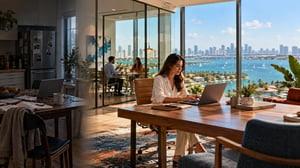
Remember when the kitchen table felt like freedom? No commute, no dress code, coffee whenever you wanted it. Six years on, a lot of professionals are quietly admitting what the spare bedroom has cost them: longer days, fuzzier boundaries, and the sense that their best work happens somewhere else.
That feeling is no longer just anecdotal. A growing body of research in 2026 points in the same direction. The home office was a useful emergency measure, but for many people, a real workspace is where focus, growth, and momentum live.
What the numbers actually say
The most telling studies don't rely on surveys asking people how productive they feel. They measure output.
At a large IT services company, researchers tracked more than 10,000 professionals after they moved home. Hours worked rose by roughly 30 percent, including an 18 percent jump in after-hours work, yet output stayed flat. Put simply, people worked longer to produce the same amount, and productivity fell by about 20 percent. Time spent in meetings and coordination grew, while uninterrupted focus time shrank (Gibbs, Mengel and Siemroth, Journal of Political Economy: Microeconomics).
A randomized study by economists at MIT and UCLA found something similar. Workers assigned to work from home full time were 18 percent less productive than their in-office peers, and the gap widened over time as office-based workers learned faster (Business Standard).
Call-center data from a Fortune 500 company tells the same story from another angle. Remote workers handled 12 percent fewer calls per hour than on-site colleagues, and employees who moved from the office to home saw their call quality and promotion rates slip (Emanuel and Harrington, AEJ: Applied Economics).
To be fair, the research isn't one-sided. A well-known Stanford trial found that a hybrid schedule, with two days at home, didn't hurt performance or promotions (Bloom, Han and Liang, Nature). But notice what that finding really says: even the strongest case for flexibility keeps people in a real workspace most of the week. It's the full-time home office that keeps showing up on the wrong side of the data.
The quiet advantage: being near people
Productivity isn't only about how many tasks you check off. It's also about how quickly you learn, how fast problems get solved, and how many good ideas cross your path in a day.
This is where proximity earns its keep. A study of software engineers at a Fortune 500 firm, updated in June 2026, found that sitting near teammates increased feedback on their work by 18.3 percent and improved code quality. The biggest gains went to younger and newer employees, the people who benefit most from overhearing, asking, and being shown (Emanuel, Harrington and Pallais, NBER).
A study of more than 61,000 Microsoft employees found that when the company went fully remote, collaboration networks became more siloed, with fewer connections between teams (Yang et al., Nature Human Behaviour). Those cross-team bridges are often where new business, fresh thinking, and career opportunities come from. They're hard to build over a video call.
When home and work share a wall
There's a reason "I'll just answer one more email" happens at 9 p.m. When your desk is twenty feet from your couch, the workday never quite ends. That 18 percent rise in after-hours work from the IT study above isn't dedication. It's drift.
A 2026 roundup of workforce research found that 56 percent of remote workers struggle to disconnect after hours, and 67 percent feel less connected to their colleagues (Stealth Agents, Remote Work Statistics 2026). Longer hours plus less connection is a recipe for burnout, and burnout is the opposite of productivity.
A dedicated workspace fixes something no app can. You walk in, you work. You walk out; you're home. That physical line between the two is one of the simplest productivity tools there is.
Returning to the office doesn't mean returning to the old office
Here's the good news. Leaving the home office behind doesn't require a ten-year lease, a long commute, or a cubicle under fluorescent lights. Flexible workspaces have changed what "going to the office" can look like.
At Quest Workspaces, that might be a private office you call your own, a coworking desk for focused days, a virtual office that gives your business a professional address, or meeting rooms you book only when the client presentation is on the calendar. With 14 centers across South Florida and New York, from Coral Gables and Fort Lauderdale to Boca Raton, West Palm Beach, and 48 Wall Street in Manhattan, there's usually one close to home.
And then there are the views.
Quest One Biscayne sits on the 32nd floor of One Biscayne Tower, with unobstructed panoramic views of Biscayne Bay. It's across the street from the Metromover and a short walk to Brightline, so getting there is part of the appeal.=. Few things reset your focus like looking up from a spreadsheet to sailboats on the water.
Quest Miami Tower occupies space in one of the most photographed buildings in the city. The 47-story landmark was designed by Pritzker Prize–winning architect I.M. Pei, and its glowing, color-changing exterior is a fixture of the Miami skyline (Commercial Observer; LoopNet). Quest's 38th floor offers some of the best water and skyline views of any flexible workspace in South Florida.
These views do two jobs. They inspire the person working there, and they impress the people who visit. When a prospective client steps off the elevator and sees the bay stretching out below, your business makes its first impression before you've said a word. That's something a ring light and a bookshelf backdrop can't match.
The bottom line
The home office had its moment, and for some tasks it still has a place. But the 2026 research is hard to ignore: people who work exclusively from home tend to work longer, learn slower, and connect less. A real workspace gives back focus, feedback, and a clear end to the workday.
If your spare bedroom has started to feel more like a holding pattern than a launchpad, it may be time to come back. Book a tour at any Quest Workspaces location and see what a day at the office can feel like in 2026. Bring your laptop. Stay for the view.